


The implementation of SAP Business AI solutions is becoming a key element of digital transformation for many organizations using SAP systems. Despite the growing availability of artificial intelligence–based solutions offered by the vendor, many companies still ask a fundamental question: “Is investing in SAP Business AI profitable?”. To provide a reliable answer to this important and justified question, it is necessary to conduct a comprehensive pre-implementation analysis. Its central component is the assessment of business value and the potential return on investment (ROI).
Conducting this process ensures that the implemented technology aligns with measurable business objectives, transforming a potential expense into a strategic investment. A thorough evaluation of business value helps identify the areas in which AI can deliver the greatest benefits, laying the groundwork for a successful and valuable implementation.
The fundamental role of pre-implementation analysis
Pre-implementation analysis is a critical element of any AI-related project in the SAP environment. Its primary objective is to move beyond technological noise and anchor the initiative in solid business realities. Such a strategic assessment ensures that every stage of implementation aligns with measurable outcomes and delivers real value to the organization.
The main objectives of this analysis include:
- Identification of high-value processes: The first goal is to identify specific business areas in which AI can generate the highest return, whether through cost savings, efficiency improvements, or new revenue streams.
- Assessment of data readiness: AI models are only as valuable as the data on which they are trained. This stage includes evaluating the quality, availability, and consistency of the data required to support the proposed AI solution.
- Definition of the current and target system architecture: Proposed solutions will differ depending on whether the Client uses SAP products deployed in Public Cloud, Private Cloud, or on-premises environments.
- Definition of measurable business objectives: Vague goals lead to vague outcomes. The analysis establishes specific, measurable key performance indicators (KPIs) that will be used to evaluate project success.
- Estimation of costs, benefits, and risks: At this stage, a detailed financial and operational forecast is developed to provide a clear picture of the required investment, expected benefits, and potential obstacles.
- Development of a baseline ROI model: This initial model provides a data-driven business justification for the investment, enabling stakeholders to make an informed decision.
In the context of SAP Business AI, it is essential to align advanced functionalities and solutions with the technical capabilities of the systems and real business needs. This ensures that the solution is not only robust and technologically advanced, but also practical and effective.
SAP Business AI tools for cloud and on-premises systems
The range of options available to address Client needs can be divided into several categories, depending on system architecture:
1. Cloud-based systems
For SAP Cloud-based solutions such as SAP S/4HANA, SAP SuccessFactors, SAP Ariba, and SAP Extended Warehouse Management, SAP provides ready-made agents listed in a catalog available on the vendor’s website.
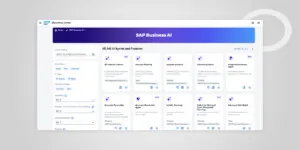
This list is continuously expanding. At the time of writing, 346 AI agents and features are available across various SAP products.
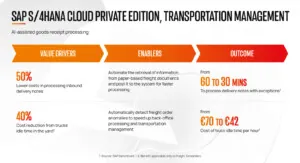
These include, for example, the SAP S/4HANA Cloud Private Edition agent and features: transportation management and goods receipt. This agent significantly streamlines the processing of goods receipts and delivery/shipping documents by eliminating data entry errors. It detects anomalies that may slow down freight order validation and automates the extraction of key information from paper shipping documents and its posting in the system, thereby reducing processing time.
The description of a given agent contains information about its business value.
In this case, it includes:
- 50% reduction in delivery/inbound shipment document processing costs, assuming a reduction in processing time for documents with anomalies from one hour to 30 minutes;
- 40% reduction in truck idle time costs for freight forwarders, assuming a cost-per-hour metric for truck downtime.
Source: SAP S/4HANA Cloud Private Edition, transportation management, goods receipt processing
Source: SAP S/4HANA Cloud Private Edition, transportation management, goods receipt processing
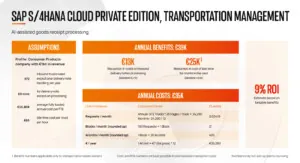
SAP has developed dedicated metrics for these agents to measure potential benefits and costs, as well as initial assumptions regarding expected changes in metric values after implementation. As a result, system users gain immediate reference points for estimating potential investment benefits.
These calculations are then compared with the Client’s actual environment, including existing KPI values and the planned frequency of agent usage (monthly number of requests). Based on this, an ROI indicator is generated for the planned investment. Partners such as Hicron have access to ROI calculators for individual agents.
In the case of SAP ERP Private Cloud, users can also leverage ready-made agents, although their number is currently more limited. However, this list is expected to expand with additional agents in line with the vendor’s roadmap, both for SAP ERP Private Cloud and other SAP solutions.
2. On-premises and hybrid system architectures
Regardless of whether the Client’s environment is cloud-based or on-premises, AI Foundation can be used. This solution provides the key tools and technologies required to build, connect, and run custom AI solutions and agents at scale.
One of the products within AI Foundation is Joule Studio, which is part of the SAP Build tool. Joule Studio enables the development of custom agents or so-called skills, which agents use in an environment that ensures data confidentiality. Joule Studio offers access to a broad range of AI models, including ChatGPT, Mistral, Anthropic, and Gemini.
An agent built in Joule Studio is deployed in an application developed using BTP services, operating on data from SAP systems (such as SAP ERP, SuccessFactors, Ariba, or EWM) or from third-party systems. SAP ERP on-premises systems and non-SAP solutions can be connected via the Cloud Connector.
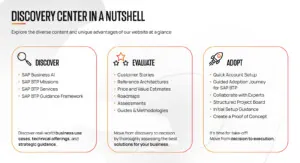
In this case, the approach to measuring potential benefits follows the Discover -> Evaluate -> Adopt model, where the assumed indicators are validated against the results of a POC to determine investment costs and revenues as precisely as possible.
Source: Discovery Center
Key elements of profitability analysis for SAP Business AI
A robust profitability assessment should be based on measurable data and realistic assumptions. It requires a systematic approach to assessing the full financial and strategic picture of SAP Business AI implementation. This process breaks the project down into manageable components, enabling detailed and accurate evaluation.
The key stages of this process are described below.
Identification and valuation of business scenarios
Every AI initiative should start by identifying specific processes that have the potential to be optimized. This may include document processing automation, predictive demand planning, intelligent procurement recommendations, or financial anomaly detection. For each scenario, it is necessary to determine the duration of the current process, the volume of operations, the cost of human errors, and potential savings or revenue growth. The outcome is a scenario map with assigned potential business value.
Calculation of implementation costs
The total cost of a finished AI solution extends beyond the initial purchase price. A comprehensive cost calculation includes software licenses and subscriptions (for example, SAP BTP, SAP AI Core, or SAP Joule), implementation services, integration and extension development, user training, and ongoing maintenance and monitoring of AI models. When using SAP Business AI, the key billing unit is the SAP AI Unit. This unit functions as a virtual currency that simplifies the use of SAP Business AI. Instead of purchasing licenses for individual AI functions, AI Units are acquired in packages and can be flexibly used across solutions such as SAP S/4HANA Cloud, SAP SuccessFactors, or SAP EWM. The packages are priced in blocks of 100 units. Forecasting AI Unit consumption is often challenging. To address this, SAP has developed calculators to estimate AI Unit usage. A detailed cost estimate should include both initial capital expenditures and long-term operating costs.
Estimation of benefits
The benefits resulting from AI implementation can be divided into operational, financial, and qualitative:
- Operational savings result from reducing manual work, minimizing errors, and eliminating process bottlenecks. For example, using AI tools from SAP can reduce the processing time of certain document types by 30%.
- Financial gains achieved through improved decision-making, such as price optimization, improved inventory turnover, and faster data monetization.
- Qualitative improvements, including enhanced user experience, greater information availability, and faster response to market events.
Each of these benefits should be translated into financial value using realistic input data to determine their quantitative impact.
Building the ROI model
While the standard ROI formula:
ROI = (financial benefits – total costs) / total costs × 100%
serves as a starting point, a comprehensive model provides deeper insight. It includes calculation of net present value (NPV) to understand the current value of the project, internal rate of return (IRR) to evaluate profitability, and payback period to determine when the investment will pay back. Sensitivity analysis of ROI across different variables helps prepare the organization for various, often unpredictable, scenarios.
Risk and barrier analysis
AI projects involve unique risks, including data quality issues, compliance with regulations (such as GDPR), user adoption challenges, and solution scalability. A thorough risk assessment directly affects the projected effectiveness of the investment and should be an integral part of the analysis.
In this area, SAP also provides dedicated support for AI users within its solutions. A key competitive advantage of SAP solutions lies in data security and confidentiality, including:
- no training of external LLMs: Client data is not shared with external providers for model training;
- tenant isolation: Client data is never accessible to other tenants;
- consent-based model training: when model retraining is required, Client data is used only with explicit consent and anonymized where necessary;
- SAP-hosted AI infrastructure: SAP offers locally hosted AI models (for example, Mistral and Aleph Alpha).
Final recommendation and implementation roadmap
A reliable analysis should conclude with a clear set of outcomes. This includes a list of recommended implementation scenarios ranked by profitability, a phased implementation schedule with pilot stages, and a results measurement plan aligned with defined KPIs. Such a roadmap provides the organization with a clear path forward.

Why a thorough analysis is your best investment
The decision to implement SAP Business AI is a significant strategic move. Insights derived from fundamental analysis and detailed profitability assessment together form a coherent business case. This structured approach eliminates uncertainty surrounding the planned investment by grounding it in data-driven forecasts and clear objectives. It shifts the discussion from “Should we invest in AI?” to “How can we best leverage AI to achieve our strategic goals?”.
A thorough analysis helps eliminate the risk of unsuccessful investments, while also accelerating business processes and reducing costs on a much larger scale. Specialized research indicates that many AI investments are overestimated. According to the McKinsey report The State of AI in 2025: Agents, innovation, and transformation, respondents report cost and revenue benefits at the level of individual AI use cases, and 64% state that AI supports their innovation efforts. However, only 39% report an impact on EBIT at the enterprise level.
Partnering with Hicron for secure AI transformation
The implementation of SAP Business AI should be preceded by a detailed pre-implementation analysis focused on profitability. Only a precise assessment of costs, benefits, and risks allows an organization to determine whether the investment will deliver the expected returns. A professional approach ensures that key decisions are based on reliable data and a full understanding of SAP Business AI’s potential.
Navigating this complex landscape requires more than technology alone; it requires expertise. At Hicron, our experts combine deep knowledge of SAP solutions with a strategic business approach. We guide your organization through every stage of analysis, helping build a solid business case and a secure path to success. By working with Hicron, you gain confidence that your AI investment is not merely a technological upgrade, but a strategic driver of growth and efficiency.
Would you like to learn more about the benefits of a thorough AI profitability analysis? We invite you to participate in our workshops focused on AI and SAP Business AI pre-implementation analysis.